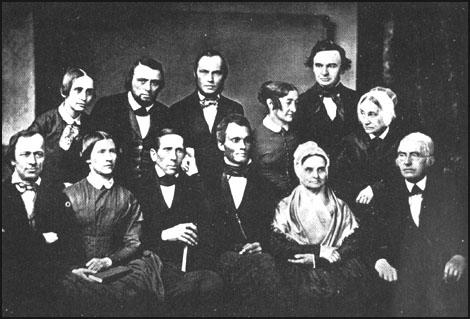
The American Anti-Slavery Society, or AASS, was founded in Philadelphia on December 4, 1833. Its leaders included William Lloyd Garrison and Arthur Tappan. The organization brought together abolitionists who wanted to make ending slavery a national priority (Library of Congress, “The American Anti-Slavery Society”).
When Americans talk about freedom, we often think about the Declaration of Independence and the idea that everyone is created equal. But in the 1800s, slavery made that promise impossible for millions of people. The American Anti-Slavery Society was one of the organizations that challenged this contradiction.
The AASS believed that freedom could not wait.
At the time, some people supported gradual emancipation, meaning slavery would end slowly over time. The AASS rejected that approach. Its members argued that enslaved people deserved freedom immediately and without compensation to slaveholders. They also connected their beliefs to the Declaration of Independence and its promise of equality (American Anti-Slavery Society, Declaration of Sentiments).
The society used several ways to spread its message. Members gave speeches, published newspapers and pamphlets, organized local chapters, and sent petitions to Congress. The organization also encouraged boycotts of cotton and other products made through slave labor (Library of Congress, “American Anti-Slavery Society”).
The movement grew quickly. By the 1840s, the AASS had become a major national abolitionist organization. Its publications and public lectures helped bring antislavery ideas to people throughout the country (Library of Congress, “American Anti-Slavery Society”).
One of the most important parts of the AASS was its connection to Black abolitionists.
Frederick Douglass became one of the movement’s most influential speakers. In 1841, after speaking at an antislavery meeting, Douglass was hired as an abolitionist speaker and became closely connected with William Lloyd Garrison and the abolitionist movement (Library of Congress, “Frederick Douglass Timeline”).
The society also faced serious opposition. Some Americans believed abolitionists were threatening the country’s stability. Antislavery activists faced harassment and violence because of their beliefs.
The AASS also had disagreements within its own ranks. Some members wanted to work through politics, while others, including Garrison, believed the Constitution itself supported slavery. These disagreements eventually caused divisions within the abolitionist movement.
Even with those problems, the society made a lasting impact. It helped organize people around the idea that slavery was a national injustice. It also helped keep abolition in the national conversation through speeches, publications, and activism.
The AASS did not end slavery by itself. The Civil War, the Emancipation Proclamation, and the Thirteenth Amendment were all major parts of the process. However, the society helped build the abolitionist movement that pushed the country toward emancipation.
The organization eventually dissolved in 1870, five years after the Thirteenth Amendment abolished slavery (Library of Congress, “American Anti-Slavery Society”).
The American Anti-Slavery Society matters because it shows that freedom is not just an idea—it is something people have to fight to make real.
Its members challenged America to live up to its own promises. Their work reminds us that major changes often begin with people who are willing to question what society has accepted for too long.
Works Cited
American Anti-Slavery Society. The Constitution of the American Anti-Slavery Society: With the Declaration of the National Anti-Slavery Convention at Philadelphia, December, 1833. 1838. Library of Congress.
Library of Congress. “American Anti-Slavery Society.” A Nation of Joiners: Voluntary Associations in America, Library of Congress.
Library of Congress. “Frederick Douglass Timeline.” Frederick Douglass Papers, Library of Congress.



No comments:
Post a Comment